Happy Juneteenth, Y'all!

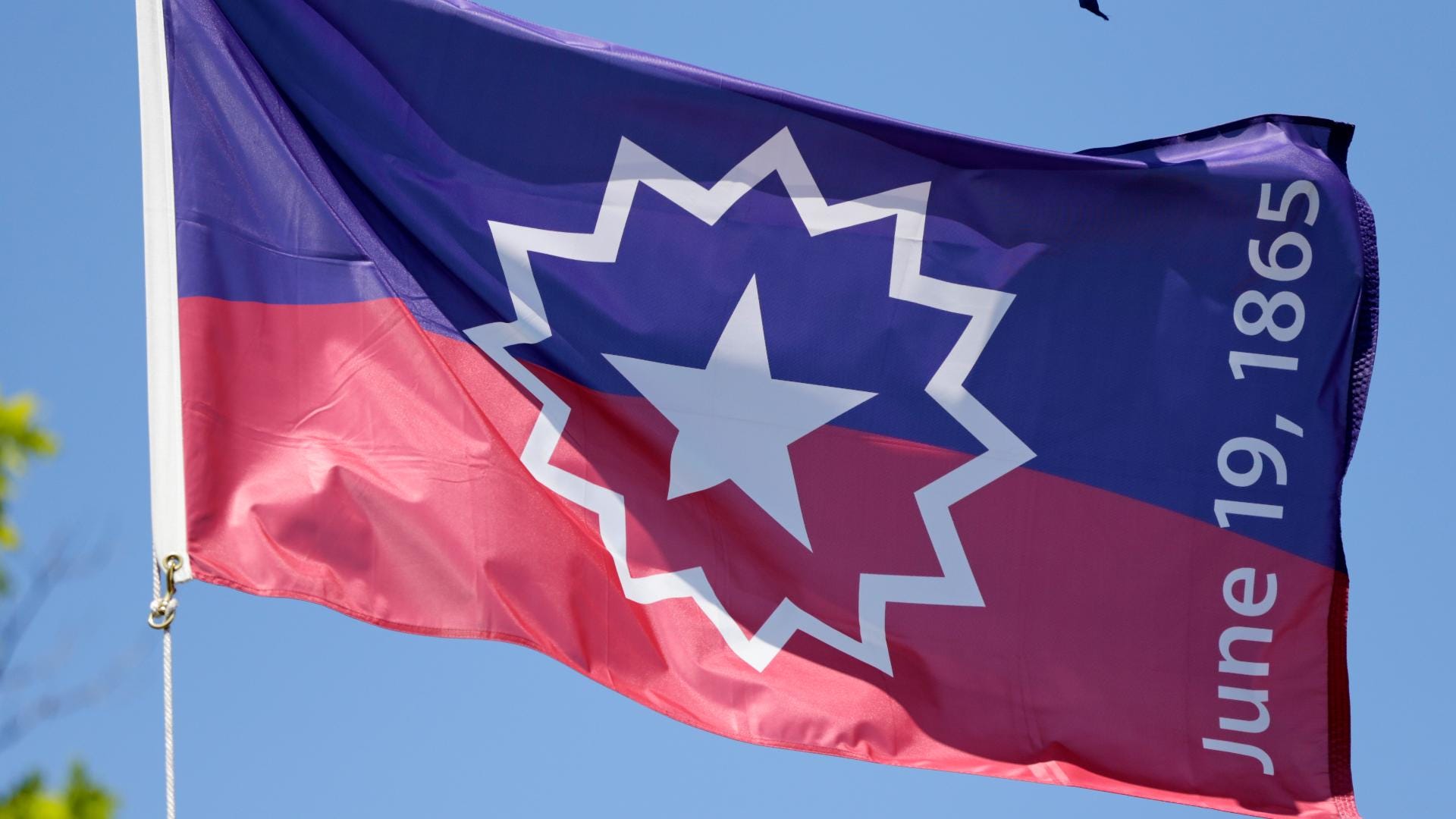
I originally intended for this post to go live earlier this week, but as life would have it, that didn’t happen. I’m actually glad it didn’t though, because today (as I write this) I watched the opening ceremony for the new Obama Presidential Center and I feel like this post is going to take on a whole different tone now. Earlier this week, I was irritated as I wrote and I was planning to start this post talking about some nonsense I had seen on social media about Michelle Obama, which I presume came from the MAGA crowd. Subsequently, another video about the situation came up in my feed from Lynae Vanee, and I will still link it, but that’s not what I want to focus on anymore. Michelle Laverne Robinson Obama is and will forever be the epitome of what the First Lady of an aspirational version of this country should be. They hate her because she inspires us. And they will just have to be mad forever. Her legacy, and President Obama’s, are solidified.
Video Link:
Hearing the speeches and the intention and vision behind what was included in the center was very inspiring. As I am sitting here editing this, it is also the night before Juneteenth. And as I reflect on all I have learned in the past year since the last Juneteenth, and all that I witnessed today during that ceremony, I have mixed feelings. It was W.E.B. Du Bois who described what I feel as “double consciousness”. One might argue that my views have shifted slightly more radical in this last year, because of all that I’ve learned about Black history and Black history in America, specifically. So on the one hand, I’m excited to observe Juneteenth and all that it represents. It is a day to commemorate the realization of freedom for a select few who were previously enslaved. That deserves celebration and reverence.
At the same time, I am enraged. I’m enraged about the truth of America’s history, and how those with power continue to play in our faces day after day. How circumstances both then and now are because of a select few men with money and power who continue to manipulate and violently uphold a system that places them at the top of an imaginary hierarchy. Why is it so hard for some people to imagine that everything could be better for everyone if we leveraged the power of the collective?
As I discussed in my last post, one of the most insidious features of white dominance culture is the fact that it orients us all around whiteness. But, as Toni Morrison tells us, the very function of racism is distraction. It distracts us from our work, from what is truly meaningful and impactful. I think Lynae is brilliant, and I appreciate the time and effort she puts into putting out content that is informative and affirming for Black women and Black people in general. That said, it took her time and effort to put that video together. It also involves the emotional toll the constant hypervigilance against racism requires for people in the activist and liberation spaces. Imagine what she could do if she didn’t have to spend so much time responding to racist nonsense?
I suppose it is her choice to use her time that way. And I’m grateful there are people like her who do because hate and vitriol are also part of the zeitgeist, so we need voices out there to counter that. But hate and vitriol are also currency online. The internet economy thrives off of this reality. The media is complicit. The way we receive our news here in America shifted when the rules changed in 1987, following the repeal of the Fairness Doctrine. Allowing news to become an avenue for media companies to make more money is one of the worst things that ever happened to our “democracy.” Without balanced coverage of the issues, it was only a matter of time before polarization worsened and we got where we are now.
I don’t know if it can be fixed at this point. I don’t know if we could ever go back. Not with our current capitalist economy. There would have to be a significant shift in our collective values for this to change. But it doesn’t have to be all or nothing. One of my favorite motivational quotes is Margaret Mead’s: “Never doubt that a small group of thoughtful, committed citizens can change the world; indeed, it’s the only thing that ever has.” One of the ways I try to be intentional about how I engage with social media is by scrolling past ragebait. When I dislike or disagree with something, or if it seems like it’s something fishing for clicks, I try to keep scrolling. The algorithms don’t care if you’re commenting or sharing something to “hate post” or say something negative or contradicting. It only cares that you shared it or engaged with it. If we want to see less of something, we have to ignore it. We have to make ragebait less profitable.
I am still figuring out how to shift my liberation work efforts towards empowering the Black community rather than trying to make a case for our humanity with those who refuse to see it. What I do know is that knowledge is power. So when in doubt, I try to learn something new. Now, I was taught that Juneteenth, also known as Freedom Day and Emancipation Day, is the day we celebrate the last of the enslaved Africans in America being freed. This occurred on June 19, 1865, two years after the Emancipation Proclamation was signed. On that date, Union soldiers made it to Galveston, Texas, to inform those who were still in bondage there that they were free. However, what I recently learned from this video is that these people were not the last of those who were enslaved. Why did so many people remain in bondage so long after the Emancipation Proclamation? If you guessed because of racism, you are correct. The slave owners did not want to free their slaves; they wanted to continue to exploit their labor. The entire economy that developed in America was based on slave labor. Ain’t that some shit?
As described by social justice activist LaTosha Brown in another post I saw earlier this week, the capitalist economy isn’t racist just because of the exploitation of Black labor. It was literally built off the bodies of enslaved people. Their bodies were literally collateral, used to trade and borrow against for loans. I’m linking the article here as well, but please note that it’s behind a paywall. This is just another reason why we must celebrate Freedom Day. And this is why we continue to fight for liberation. Because though we are no longer living in bondage, we are still not free.
So how do we celebrate Juneteenth? I think it’s important that we celebrate in community. Many cities and municipalities around the country host different events and festivals for Juneteenth, and often they are free (at least they are where I live). So I’d encourage you to check to see what’s happening in your area. Another way to celebrate is to participate in some sort of educational activity. Watching the video I linked above is one option. Juneteenth gives us an opportunity to honor our ancestors, so another way to do that is by taking part in some of our historical cultural traditions. Those vary from region to region, perhaps even family to family, but my favorite would be food. I don’t know where I’m going to get it yet, but I plan to have a plate of somebody’s soul food tomorrow.
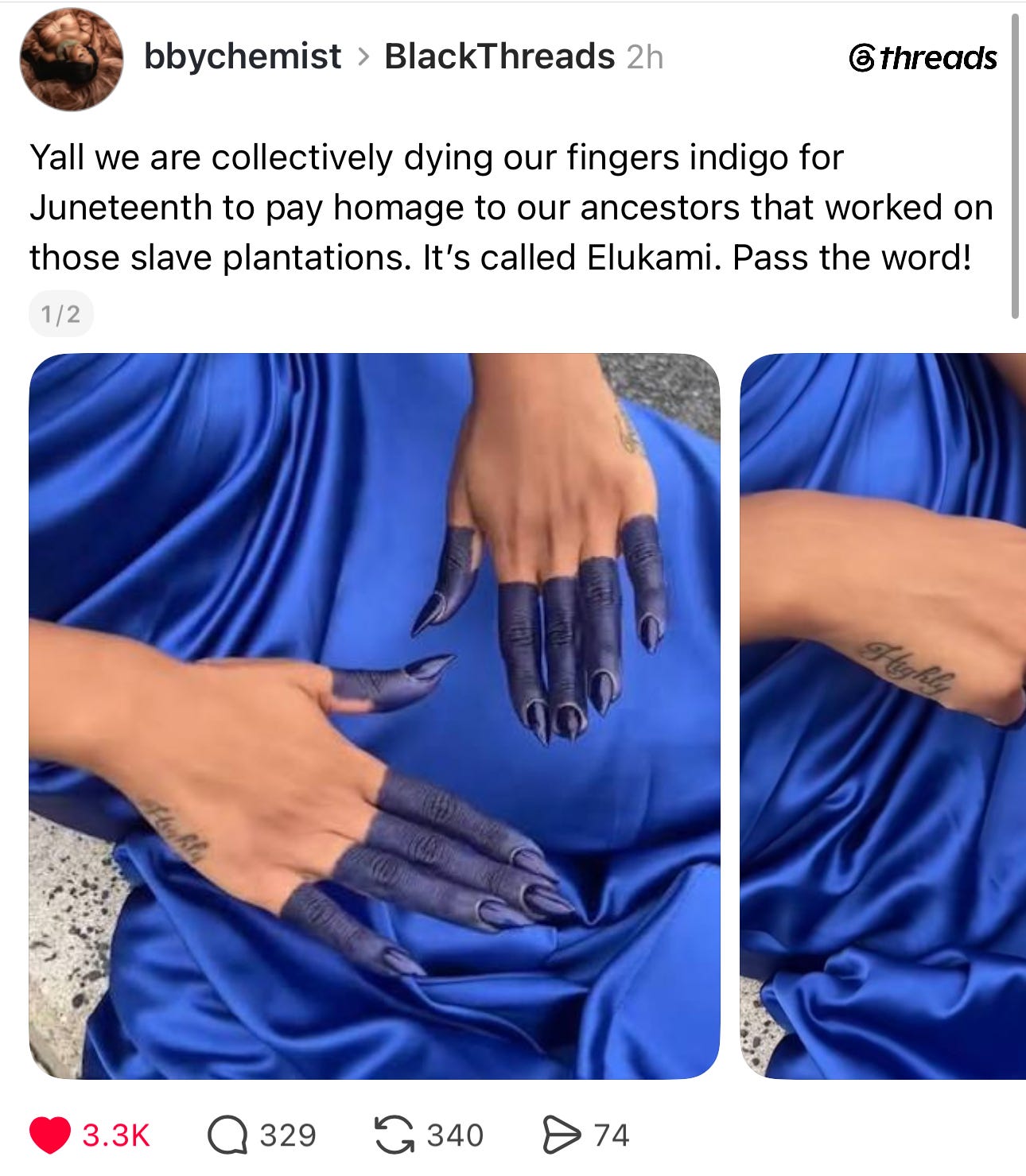
Another trend I’ve seen floating around social media is this trend being called “Elukami”, which, according to this video, is similar to other cultural practices around the world with body art such as henna. With Elukami, indigo is used as the dye for body art, in honor of the ancestors who worked on indigo plantations in the south. This is especially intriguing to me because I remember in my class on women in management, the indigo industry was referenced. But the success was credited entirely to a white woman named Eliza Pinckney, for her success as a business owner in a time when women weren’t typically allowed to own or run businesses. The name of the assignment and video we watched was “Women of Impact”, which framed her success as solely the result of her own effort. I’m not saying that she shouldn’t be celebrated. As a woman, she did have to deal with patriarchy, so being successful was indeed a feat in her time. But let’s be honest about the totality of where her success came from. It came from the unacknowledged and exploited labor of people who were enslaved. People who look like me.
I remember being conflicted about whether I should bring up the fact that it felt like the history we were learning about in the class heavily centered on white women, with women of color being peripheral or an afterthought. There were other women of color referenced, but their contributions weren’t centered or highlighted to nearly the same extent as those of white women. This is an example of how mainstream feminism often fails women of color. But the professor was also a white woman, and prior experience told me that this conversation could potentially be a battle, and I wasn’t sure I had the capacity for it at that time (I’ve also read White Fragility). At that point, I was just trying to get through the class with a passing grade. I didn’t want to start anything that could be perceived as drama, as is often the case when Black women speak up.
But to this day, I regret that I didn’t say anything. In some ways, it was a missed opportunity to be the person I know I am meant to be. I could have potentially started some good trouble. Or the professor may have been totally receptive to updating the analysis in her content. Since I didn’t use my voice then, I’ll never know. But seeing this Elukami practice is especially meaningful to me because it acknowledges the truth of our history. And while I won’t be dyeing my fingers, I did paint my nails with a deep blue shade in honor of the memory of those unacknowledged men and women. The nail polish I used is the shade “Vintage Jordache” from the Black woman-owned brand Jessie Monroe Nail Care.
Though there is still much work to be done, Juneteenth is important to celebrate because cultural memory is integral to legacy. Our ancestors endured unimaginable atrocities for us to exist today. If not for their prayers, their labor, their blood, sweat, and their tears, America would not be what it is today. It’s probably safe to anticipate that these facts will largely be left out of whatever narrative about the 250-year anniversary ends up in the major [read: bought] news outlets, especially as we get closer to July 4th. But those narratives also tend to leave out one other very important aspect: through all they endured, our ancestors managed to also create their own joy. And I’d like to believe that some of them were able to create their own peace. They practiced community as best as they could, and they supported each other through their struggles, often at great risk of being punished. They had hope for a better future. These things were critical for our collective survival. Juneteenth offers us an opportunity to remember that as well. It’s up to us to carry that legacy forward.
Love and light always,
Domi
If you’re interested in more frequent updates on what I’m learning or thinking about, follow me on Threads/Instagram/Tik Tok @DomiTheeMuse